The Three Areas Defining Performance in the Maturing Flex Market
The flexible office market has changed dramatically over the past five years.
What was once viewed as a niche within commercial property has become one of the sector’s most important growth areas. Flexible workspace is now a core revenue stream for operators, landlords, and investors alike.
But as the market matures, the challenge is shifting.
Demand isn’t the problem anymore.

The question is increasingly becoming:
How do operators maximise profitability and performance from the opportunity already in front of them?
From our work supporting brokers, operators and office outfitters over many years, one thing became consistently clear: Revenue and margin are rarely lost through one major failure. They’re lost through friction across the enquiry-to-lease journey.
Small delays. Disconnected systems. Poor visibility. Inconsistent data. Weak first responses. Processes that become harder to manage as complexity increases.
And as operators grow, these issues compound quickly.
Three themes repeatedly emerged as the biggest drivers of performance.
1. How enquiries are handled
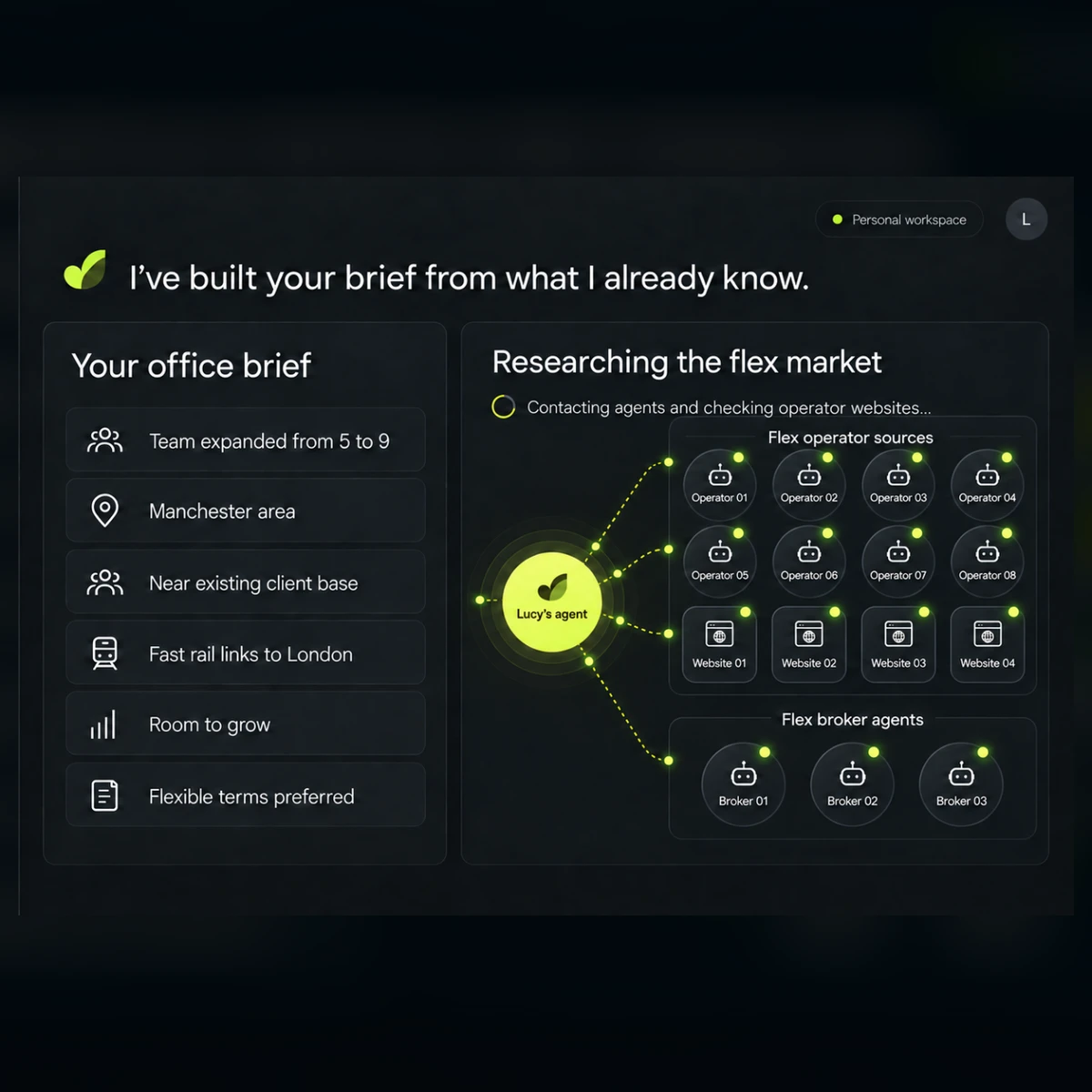
The biggest opportunity often sits in the first few minutes after an enquiry lands.
Conversion is not simply about lead volume. It’s about the speed and quality of the first response.
This became increasingly clear at scale.
A single enquiry might appear low value on the surface. For example:
- one desk
- one location
- one short-term requirement
But in reality, that same enquiry could become:
- a project team
- multiple desks
- multiple locations
- an ongoing corporate relationship
Many operators we’ve spoken to said an enquiry for five desks often became ten once the client visited the premises. The challenge is that you rarely know the true value of a lead immediately.
Operators, therefore, need to think beyond simple lead distribution.
The highest-performing workflows tended to:
- segment high and low value enquiries quickly
- route enquiries based on context, not just size
- balance automation with human expertise
- prioritise speed without sacrificing relevance
Signals such as market location, company profile, enquiry type, and requirement size all became useful indicators.
One of the more useful signals was the IP address and the company context.
For example, an enquiry for two desks in somewhere like SoHo in New York could mean very different things depending on who was enquiring.
It could be:
- an early-stage startup with limited growth potential
- or a major corporation creating a small project space close to startups, clients or partners
On the surface, both enquiries may look identical. In reality, one could become a significant long-term account.
That’s where contextualised routing started to become important.
None of this was ever perfect. The objective was not to build a flawless scoring system, but to improve the likelihood of a fast, relevant and credible first response.
Even smaller operators without complex systems can improve performance significantly by focusing on this principle alone. While larger operators may use complex algorithms and AI to support decision making, for many businesses, the biggest improvement can come from something far simpler: getting the first conversation right when that enquiry comes in.
Because when demand is high and competition is immediate, speed and relevance matter.
2. How systems are integrated
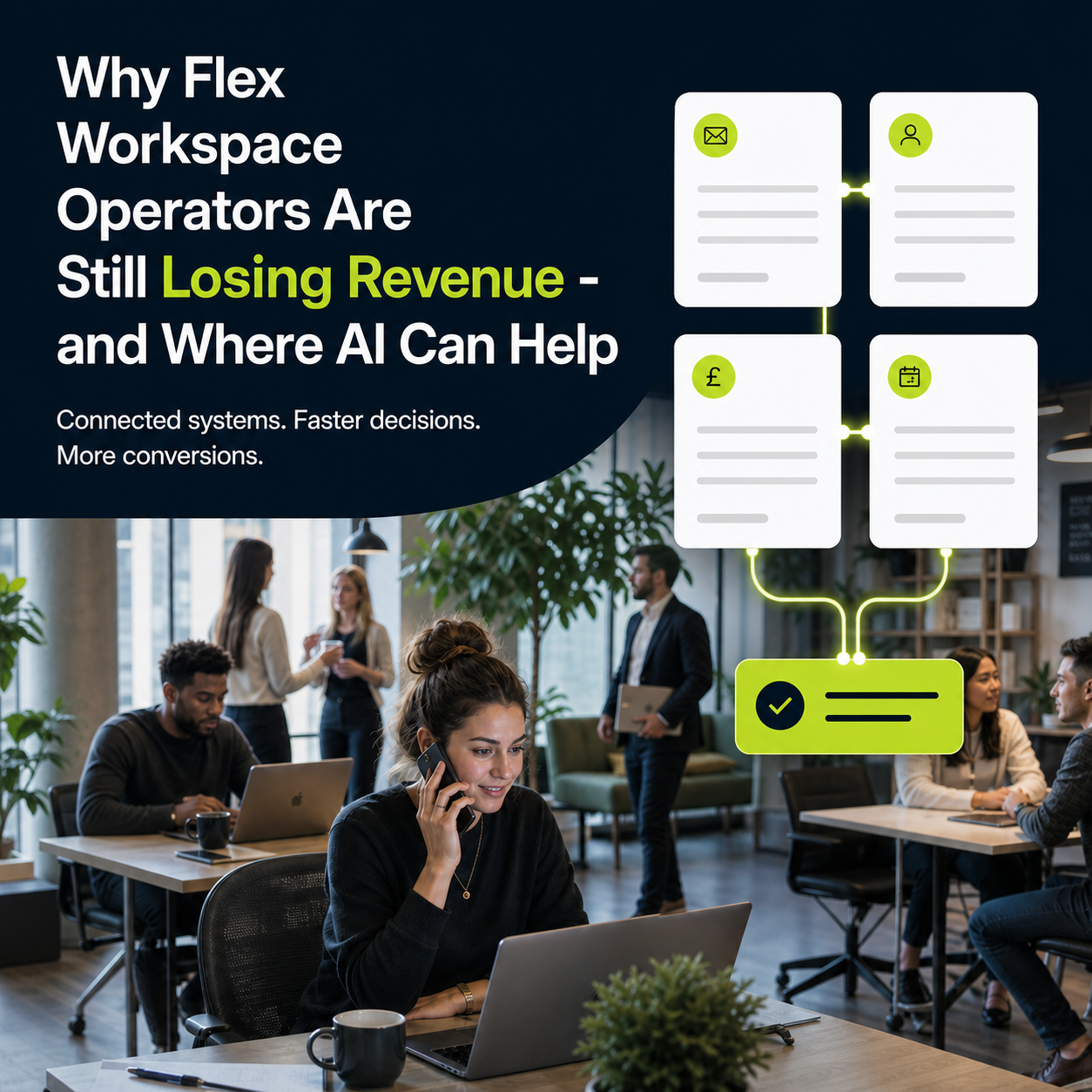
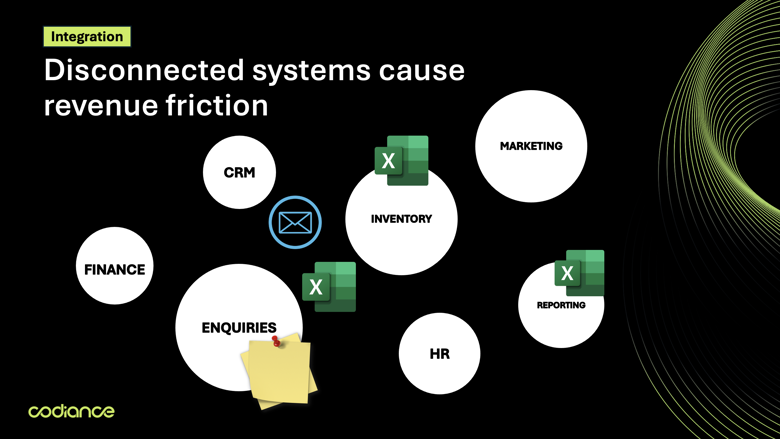
Most operators do not lack systems.
They lack connected systems.
CRM platforms, inventory systems, finance tools, marketing systems, websites, enquiry handling tools, and reporting platforms. Most businesses already have them.
The problem is often what happens between them.
At scale, disconnected systems create operational friction:
- slower response times
- inconsistent customer experiences
- duplicated effort
- manual workarounds
- reduced confidence internally
This is where performance begins to suffer.
When teams stop trusting the flow of information, they start creating their own processes:
- spreadsheets
- notes
- offline conversations
- duplicated tracking
And over time, the business starts working around the systems rather than through them.
This was one of the major lessons from bespoke platform development within the flex market.
Initially, bringing more functionality into a single central system improved speed and visibility significantly.
But over time, many of these platforms expanded to absorb more and more responsibility as new operational problems emerged.
The result was often systems that became increasingly difficult to adapt as the market evolved.
That was an important lesson.
The answer is rarely at either extreme. Fully bespoke platforms create one set of problems. Fully off-the-shelf approaches create another.
The strongest long-term approach is often:
- building the elements that genuinely differentiate the business
- integrating specialist systems around them
- improving visibility and flow across the entire journey
In mature flex operations, integration is no longer a technical nice-to-have.
It directly impacts conversion, operational efficiency, and ultimately profitability.
3. Establishing a single source of truth
The final theme - and arguably the most important - is data.
Poor data creates friction everywhere.
Externally, it leads to:
- inconsistent listings
- outdated imagery
- inaccurate availability
- irrelevant recommendations
Internally, the impact is often even greater.
Once teams lose confidence in the data:
- systems get questioned
- workarounds emerge
- conversations replace visibility
- decision-making slows down
In some cases, we saw the same building displayed differently across multiple websites. In others, properties remained live that no longer existed.
The consequence is immediate.
Customers lose confidence. Teams lose trust. Performance suffers.
And critically, operators lose visibility of where revenue is actually being won and lost.
This is why establishing a clear source of truth becomes foundational as flex businesses scale.

Trusted data enables:
- faster and more effective responses
- better operational decision making
- clearer visibility of conversion performance
- scalability without operational chaos
One of the most overlooked steps in improving operational performance is simply mapping where data currently exists and how it flows through the business.
Without that understanding, it becomes extremely difficult to make informed decisions about systems, automation, reporting, or AI adoption.
As the flex market matures, operators with better visibility across enquiries, systems, and data will be best positioned to improve profitability and maximise asset performance.
The opportunity is no longer simply growth. It’s operational maturity.
For over 15 years, Codiance has worked with IWG and the Instant Group, helping operators, brokers, and office outfitters get more from their systems and remove revenue friction across the enquiry-to-lease journey.
If you’re looking to improve conversion, tighten your process, or understand where revenue is being lost, we’re happy to share what’s worked and where we’ve seen the biggest impact. Get in touch.