Bringing AI-Powered Content Creation Directly into Umbraco CMS

At Codiance, we recognise that while AI-generated content is everywhere, many implementations feel disconnected from the way content teams actually work. The typical process involves copying content from the CMS, pasting it into an external AI tool, generating new text, and copying it back. This disjointed workflow can lead to formatting issues, inconsistent writing styles and a gradual dilution of the brand’s tone of voice, making it harder for content teams to maintain a cohesive and editorially consistent experience. We wanted to explore a better approach by integrating AI directly into the editor itself.
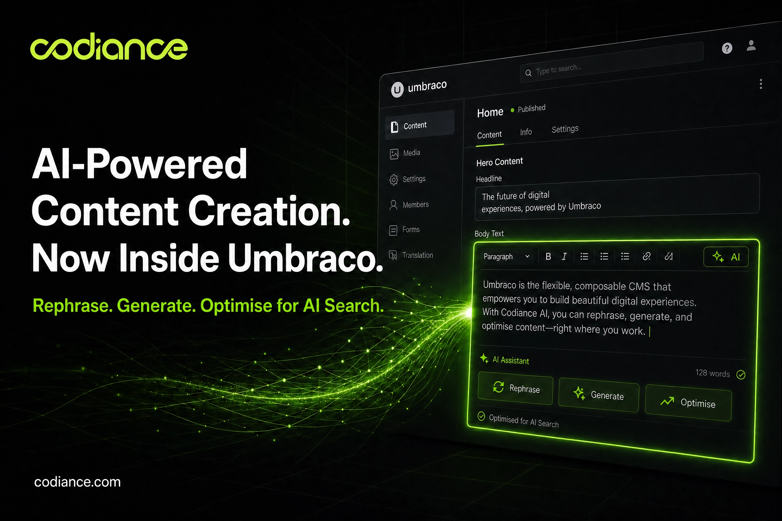
Umbraco is one of the world's leading open-source content management systems, trusted by organisations of all sizes for its flexibility, ease of use, and strong developer community. We’ve come up with a way to make Umbraco even better. Our solution is a custom AI-powered content assistant built natively into Umbraco 17. It helps authors rephrase content, generate new text, and optimise for AI-powered search experiences without ever leaving the backoffice.
By extending Umbraco's TipTap rich text editor (RTE) with a custom toolbar action, we have created a dedicated Super Text Editor (STE) side panel. Content authors can now work with AI-enhanced content in the exact same environment where they manage their daily tasks.
From a user perspective, this integration feels like a natural part of Umbraco rather than a separate application bolted onto the side. For content teams, this reduces context switching, accelerates content creation, and improves the consistency. It also helps prepare content for both traditional search and increasingly important AI-powered discovery experiences.
How It Works
The STE currently provides three core capabilities designed to streamline the editorial process. Authors can:
- rephrase existing content while preserving the original tone
- generate entirely new content
- optimise text for Generative Engine Optimisation (GEO)
One feature that has proven particularly valuable is tone management. Instead of treating tone as a simple prompt parameter, our solution allows authors to either select a specific tone or infer it from existing content. This ensures that newly generated text maintains consistency with the organisation's voice rather than sounding like generic AI output. For content teams, maintaining this consistency is often more important than the generation itself.
The interface presents two rich text editors: Source Text and Working Draft. The source text displays the original content, while the working draft contains the result of a rephrase or generation operation. Authors can easily review, edit, and replace the original text with a single click.
Optimising for AI Search (GEO)
As search habits evolve, users are increasingly asking complete questions directly to AI assistants. Content is now judged on how effectively it answers those specific queries. To support this shift, our editor allows content to be associated with primary and secondary GEO questions.
These questions drive the text rephrase and content generation processes. The AI can even analyse the existing content and suggest potential GEO questions based on the topics covered. This provides a useful starting point when shaping content around user intent and discoverability. Content editors can then evaluate how well their text supports those questions through relevance scoring, creating a continuous feedback loop where content and objectives are refined together.

Real-Time Streaming Experience
Nobody enjoys waiting to see if an AI has generated something useful. To address this, we implemented real-time Server-Sent Events (SSE) to stream responses directly into the editor. As content is generated, authors see the working draft appear progressively, word by word.
To ensure a smooth user experience, our custom Umbraco controller acts as an intelligent proxy between the AI service and the browser. It buffers incomplete data and reconstructs complete words before updating the interface, preventing the fragmented text chunks that often plague raw AI streaming. This small architectural decision significantly improves the robustness and readability of the dynamic content.
Looking Ahead
The true value of this project lies not just in generating content, but in combining content strategy, AI, and editorial workflows into a single, cohesive experience. Content authors can now improve existing text, create new material, optimise for AI search, and preserve brand voice all without leaving the CMS.
As AI-powered search and content discovery continue to evolve, we believe more organisations will seek ways to make AI a native part of their content creation process. We are excited to showcase this unique capability to our clients and explore how it can transform their digital experiences. If you are interested in seeing the Super Text Editor in action, we are now offering demonstrations to our council and enterprise Umbraco clients.