Why Flex Workspace Operators Are Still Losing Revenue - and Where AI Can Help
Flexible workspace operators rarely lack technology. The bigger problem is that their systems, data and teams often operate separately.
An enquiry may arrive through one platform, while availability sits somewhere else. Pricing might be held in a spreadsheet, occupancy data in a reporting system and customer history in the CRM. Before responding, someone has to assemble the complete picture manually.
That delay creates revenue friction. Prospective customers have to wait longer, but often don’t, sales teams spend time searching for information and operators risk losing opportunities they have already paid to generate.
AI can help, but the opportunity is not simply to add another tool.

What does removing revenue friction look like?
Most practical AI opportunities in the flex market support one of three outcomes:
· Accelerating customer and member journeys
· Improving the quality and speed of decisions
· Increasing operational capacity
Our work with some of the world's largest commercial property companies have brought these challenges into sharp focus. At scale, operators must manage multiple brands, channels and partner sources, alongside complex commercial processes and a high volume of time-sensitive enquiries.
In that environment, the value of AI is not that it can write an email. It is that it can shorten the critical path between an enquiry arriving and the business taking the right action.
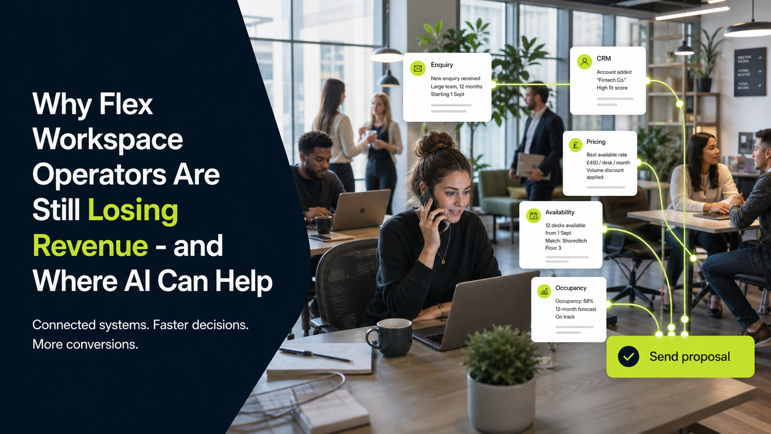
An effective system could interpret the enquiry, identify relevant locations, check availability and pricing, assess urgency, prepare a personalised response and initiate the appropriate follow-up. The salesperson remains accountable, but spends less time assembling information and more time progressing the opportunity.
AI can also introduce more signals into prioritisation. Team size, preferred location, move-in date, availability and previous conversion patterns can help sales teams decide which enquiries require immediate attention.
The objective is not to replace people. It is to help them focus on what will driver revenue faster.

AI is only as useful as the environment around it
This type of AI depends on connected systems and trusted data.
CRM, availability, pricing, booking, website and reporting information must work together. Operators also need a clear view of live enquiries, occupancy, response times, conversion and revenue performance.
Before investing in AI, leaders should be able to answer some basic questions:
· Which occupancy and availability figures are correct?
· Which enquiries remain live?
· Is information consistent across every location?
· Can different teams reach the same answer?
· Where is data incomplete or duplicated?
Many operators already hold much of the data they need. The problem is that it remains fragmented.
If different systems provide different answers, AI will not resolve that uncertainty automatically. It may simply process the uncertainty faster.
Avoid creating another ineffective silo
Many AI products perform well in isolation. The greater opportunity is to connect AI with the wider operating environment, including CRM, workspace management, websites, booking, finance and reporting.
AI should become part of a coherent operating strategy, not another disconnected application.
That means starting with the business problem and measurable outcome rather than the technology. Will the investment increase conversion, improve occupancy, reduce response times, increase capacity or improve decision quality?
If the outcome cannot be defined, the investment is difficult to justify.
In some cases, AI will not be the best first step. Better integrations, cleaner data, rules-based automation, improved reporting or redesigned processes may deliver the required result with less cost and complexity.
This commercial discipline matters. PwC’s 29th Global CEO Survey found that 56% of CEOs said their organisations had seen neither higher revenues nor lower costs from AI in the previous 12 months. The lesson is not that AI lacks value, but that adoption alone does not create it. Value must be identified, designed for and measured from the outset.
The objective is not to maximise the use of AI. It is to maximise business value.
Governance enables adoption
As AI becomes more deeply connected to business systems, governance becomes essential.
Operators need to define which tools can be used, how sensitive information is protected, when human review is required, who remains responsible for decisions and how outputs can be monitored or audited.
Governance should not be treated as something that slows adoption. It is what allows AI to move beyond isolated experiments and be used responsibly at scale.
Join the discussion
We will explore these points at the Flex Market AI Roundtable at 2.00pm on Thursday 10th September.
Martyn Baker, Commercial Director at Codiance, will examine where AI can create measurable value within flex operations and how leaders can approach adoption strategically.
He will be joined by Dr Mabrouka Abuhmida from the University of South Wales, an Enterprise AI Architect who leads research into AI for regulated environments and has contributed to UK Government AI policy. Her research expertise will complement Codiance’s commercial and technical experience, connecting AI strategy with real-world delivery.
If you operate in the flexible office sector and would like to join the roundtable, register using the link below.