Where Could AI Remove Revenue Friction in Your Flex Workspace Business?
Artificial intelligence is firmly on the agenda for flex workspace operators.
But while AI tools are increasingly accessible, turning experimentation into measurable commercial value remains much harder.
The problem is rarely a shortage of technology.
More often, it is the operational environment surrounding it: disconnected systems, inconsistent data, limited visibility and unclear ownership. Without addressing those foundations, introducing another AI tool can add complexity rather than remove it.
Revenue friction is hiding in everyday operations
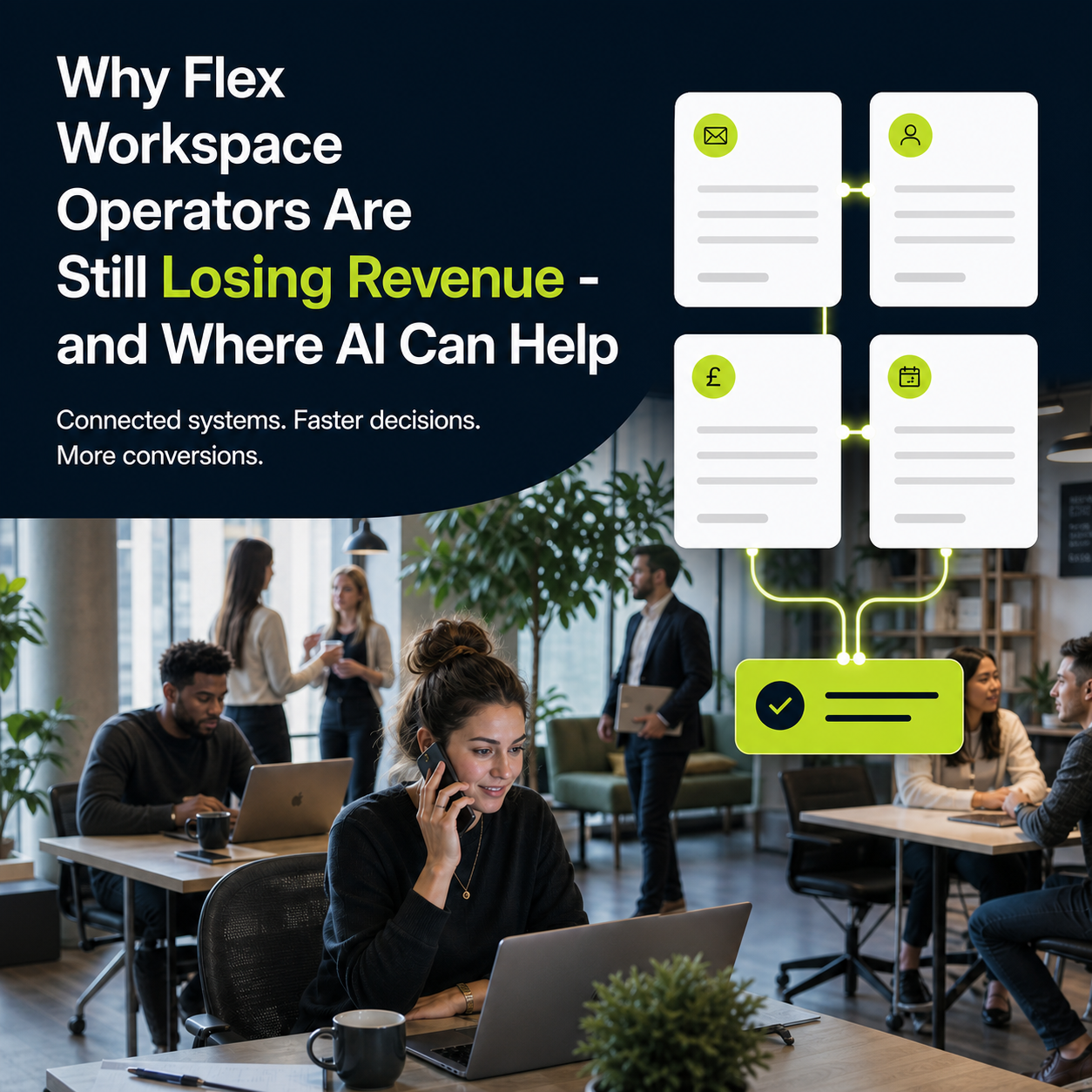
Revenue friction occurs whenever avoidable delays, inefficiencies or uncertainty make it harder to convert an opportunity into revenue.
For flex workspace operators, that friction can appear throughout the customer journey:
- Enquiries waiting to be reviewed
- Availability held across several systems
- Teams working from different information
- Manual research delaying recommendations
- Slow or inconsistent responses
- Reporting that does not provide a reliable view of performance
Individually, these issues may appear relatively small. Together, they can affect response times, conversion, occupancy and the quality of decisions being made across the business.
AI may help reduce that friction, but only when it is applied to the right problem.
The biggest opportunity may not be where you expect
When businesses discuss AI, the conversation often starts with content generation or automation.
For flex workspace operators, the more valuable opportunities may sit deeper within the operation. These can include improving customer journeys, helping colleagues make better-informed decisions and creating additional operational capacity.
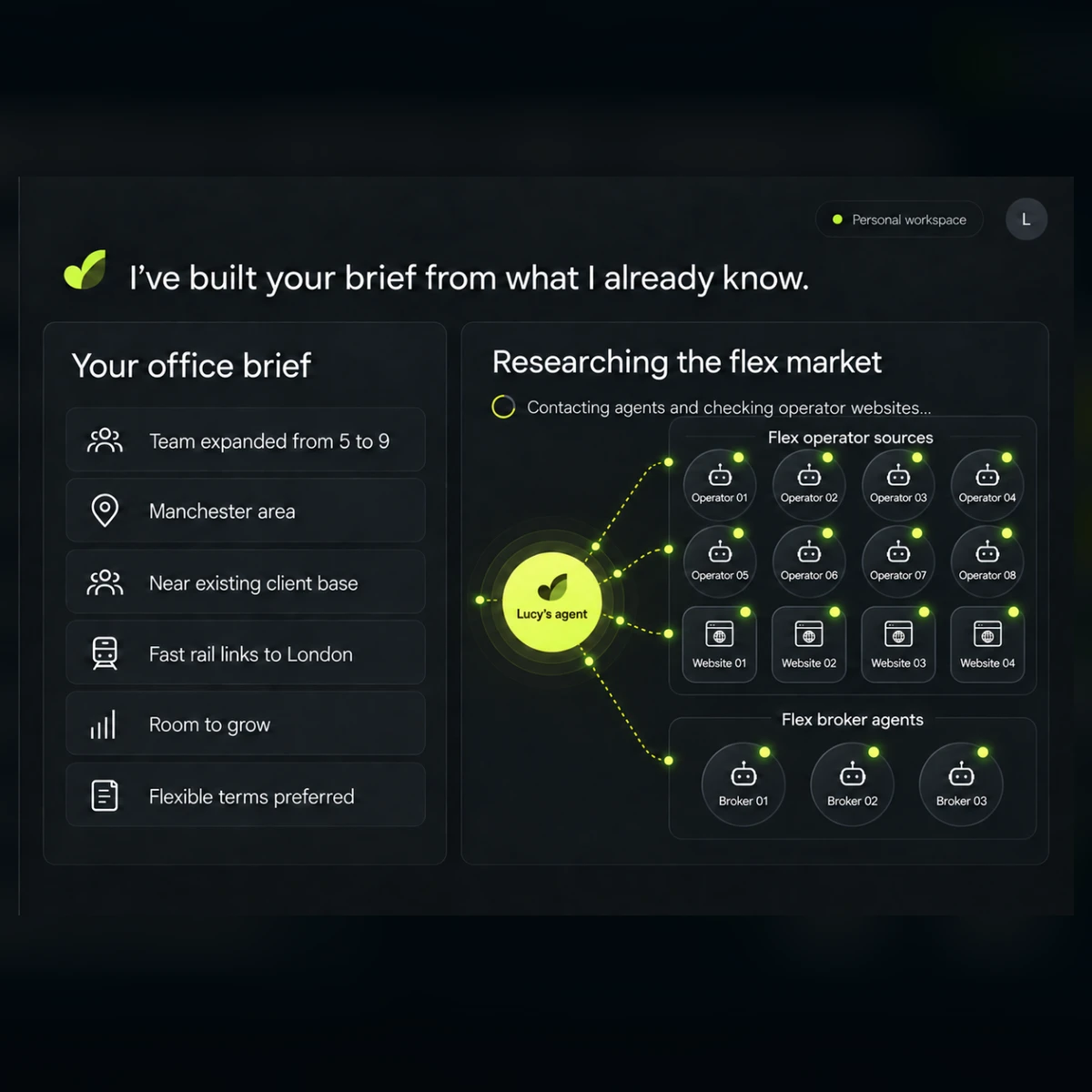
Imagine an incoming enquiry containing requirements around location, desk numbers, meeting facilities, contract length and future expansion.
Before a response can be prepared, someone may need to interpret the enquiry, check availability, review pricing, research the prospect and decide which option to recommend.
A carefully designed AI-enabled process could help bring that information together and prepare the next action more quickly. But its answer will only be dependable if the information behind it is accurate, connected and properly governed.
That distinction matters.
AI can accelerate performance, or accelerate uncertainty
AI does not automatically correct fragmented operations.
If occupancy data sits in one platform, availability in another, pipeline information in CRM and reporting in spreadsheets, a seemingly straightforward question can produce several plausible answers.
Which one should the AI trust?
This is why selecting a tool should not be the first decision. Operators need to understand where their critical information lives, how it moves through the organisation and who is accountable for its quality.
Without those foundations, AI may simply process uncertainty faster.
Start with the outcome, not the technology
The case for AI becomes stronger when it is connected to a clearly defined business result.
That might mean:
- Reducing the time taken to provide a qualified response
- Improving enquiry conversion
- Increasing occupancy
- Identifying higher-priority opportunities
- Giving teams faster access to trusted information
- Reducing repetitive administrative work
Starting with the outcome also makes it easier to determine whether AI is genuinely the right intervention.
Sometimes it will be. In other situations, better integration, clearer reporting, conventional automation or improvements to an existing system may deliver greater value with less risk.
The objective should not be to introduce as much AI as possible. It should be to remove the points of friction that are preventing the business from performing effectively.
Before investing in another AI tool
Operators need a practical way to evaluate potential AI opportunities without being distracted by individual products or short-term experimentation.
Our guide, Where AI Can Minimise Revenue Friction, explores:
- Where AI can create meaningful value across flex workspace operations
- Why promising AI initiatives frequently stall
- What trustworthy, commercially usable AI requires
- How an AI-enabled enquiry workflow could operate
- The questions to ask before selecting another AI product
- Which measures can demonstrate genuine business impact
- How to decide between AI, automation, integration and traditional software
The guide draws on themes discussed during Codiance’s AI roundtable for flex workspace operators, together with lessons from commercial property and workspace environments.
Build the foundations before scaling the technology
AI will increasingly influence how enquiries are handled, information is accessed and decisions are made across the flex workspace industry.
The immediate question is not simply where AI could be used, it's whether your data, systems, processes and governance are ready to support it.